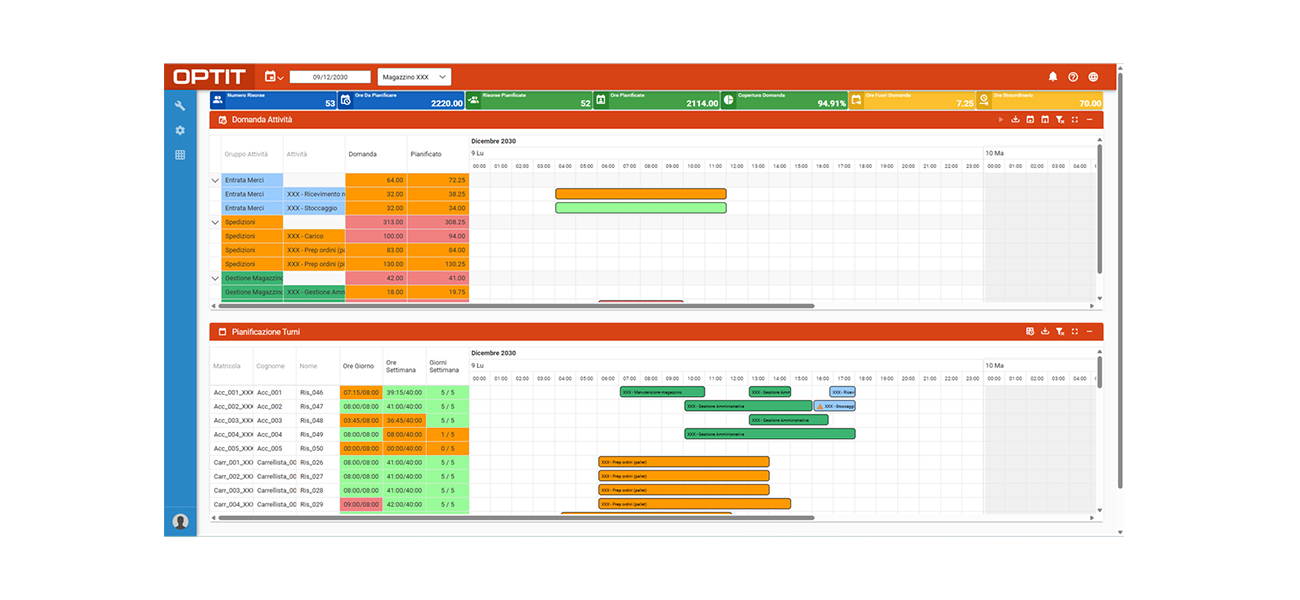
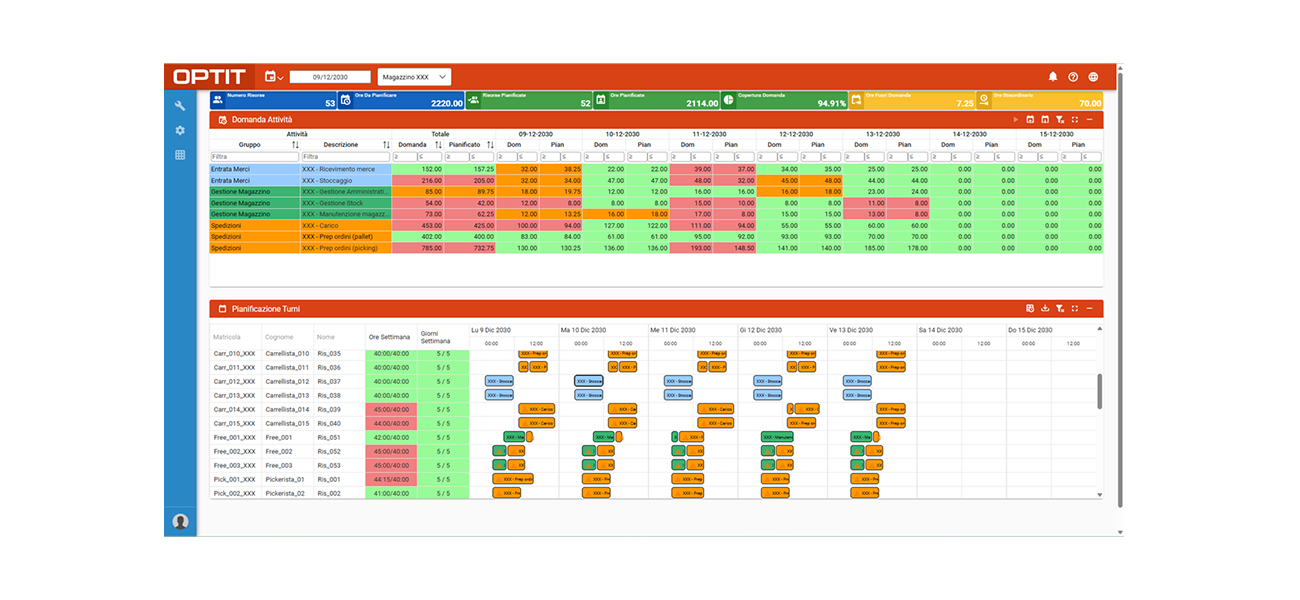
Artificial intelligence applied to Workforce Management: it optimises workforce sizing and shift scheduling to cut operating costs and maximise productivity and responsiveness to change.
Business problem
Manual shift management in complex settings creates inefficiencies that affect the whole organisation: incorrect hour utilisation, high overtime costs, and failure to meet contractual constraints and mandatory breaks. Planners lose hours every week to manual revisions; workers end up with shifts poorly aligned to their availability and skills.
OptiShiftPlanning solves these issues by automating the generation of work schedules: it assigns tasks to the most suitable resources, respecting all legal constraints and company rules, freeing up time for managers and ensuring more fairness and predictability for workers.
Our solution
OptiShiftPlanning is the AI platform for the integrated planning of human resources.
Using proprietary optimisation algorithms, it balances work demand with staff availability, ensuring full regulatory compliance, maximum decision-making agility and a better alignment between business needs and people’s needs.
How it works
The solution uses Mixed Integer Linear Programming (MILP) models to process the input data (demand, skills, contracts and availability) and generate optimal work schedules:
sizing: it defines the optimal contract mix (full-time/part-time) at the lowest cost;
scheduling: it assigns tasks to the most suitable resources, respecting legal constraints, rest periods and company rules;
integration: it connects via API to HR and business management systems.
Benefits
Savings on staff costs: cut costs by between 5% and 10% through optimisation of the contract mix.
Guaranteed compliance: automatically respect all contractual and legal constraints and mandatory breaks, eliminating regulatory risk.
Operational productivity: dynamically align the workforce with actual demand, optimising task coverage.
Management efficiency: drastically cut the time spent creating and revising work schedules each week — and give people shifts that are more predictable and aligned to their availability.
Enterprise scalability: centrally manage dozens of warehouses or hundreds of stores on a single platform.
Discover how this solution has helped other businesses