OptiLoad – Building
Optimisation of Loading
Maximise the efficiency of your loads with AI: the optimisation engine that integrates the operational, physical and commercial constraints of your supply chain to plan perfect loads in seconds.
Business problem
Transport companies must manage the complexity of vehicle fill, heterogeneous loading constraints and constant pressure to reduce operating costs, day after day.
OptiLoadBuilding provides a space optimisation engine that goes beyond geometric fit. The solution takes physical and logical constraints and loading-unloading sequences into account to deliver load plans that are genuinely advantageous and ready to use immediately.
Our solution
OptiLoadBuilding plans the optimal arrangement of goods and products of different shapes and sizes inside boxes, pallets, trucks and containers, in seconds.
It maximises the number of items loaded and volumetric fill while respecting all the operational and physical constraints of your specific business context (for example, maximum weight capacity).
How it works
The solution generates the optimal load plan, solving the inefficiencies typical of manual logistics.
The process starts by integrating data from the client’s ERP or WMS: dimensions, weight, fragility and orientation rules for each item, plus the technical characteristics of the containers (pallets, containers, load compartments, aircraft holds) with their capacity limits.
The proprietary algorithm, the intelligent engine of the solution, evaluates thousands of spatial combinations in seconds, simultaneously applying all the complex logistics constraints of the business’s operating context.
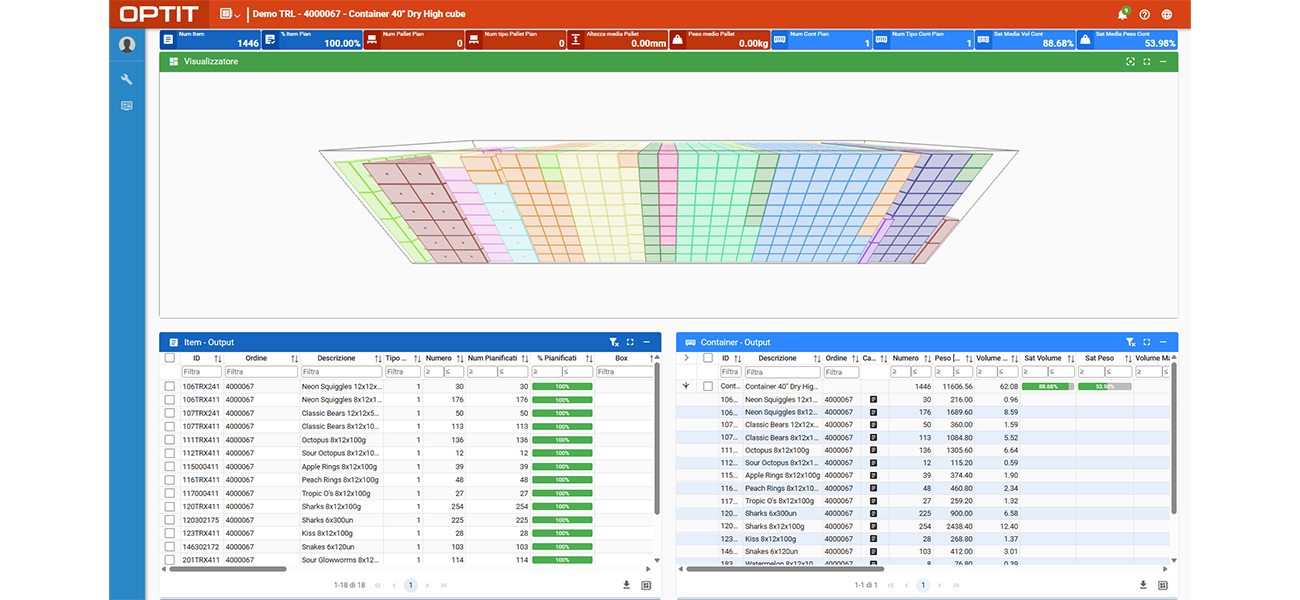
At this point, OptiLoadBuilding returns a perfectly optimised load plan. The plan is presented through an interactive 3D viewer that lets you explore the arrangement graphically, obtain the loading sequence and assess the solution’s KPIs (volumetric fill, total weight).

Benefits
Integrating OptiLoadBuilding into your business processes isn’t just about adopting advanced software; it’s a tangible change in supply chain performance.
- Lower transport costs: maximise fill and select the most economical mode for each shipment (FTL, LTL, etc.).
- Better customer service: adapt order quantities to efficient logistics units and offer more competitive transport terms.
- Operational excellence: turn the warehouse from a cost centre into an efficiency centre, thanks to automation of the loading process.
- Configurable flexibility: balance often conflicting goals through objective functions adaptable to your context and constraints.